Mock Tests: The Real Secret Behind Every Topper's Success
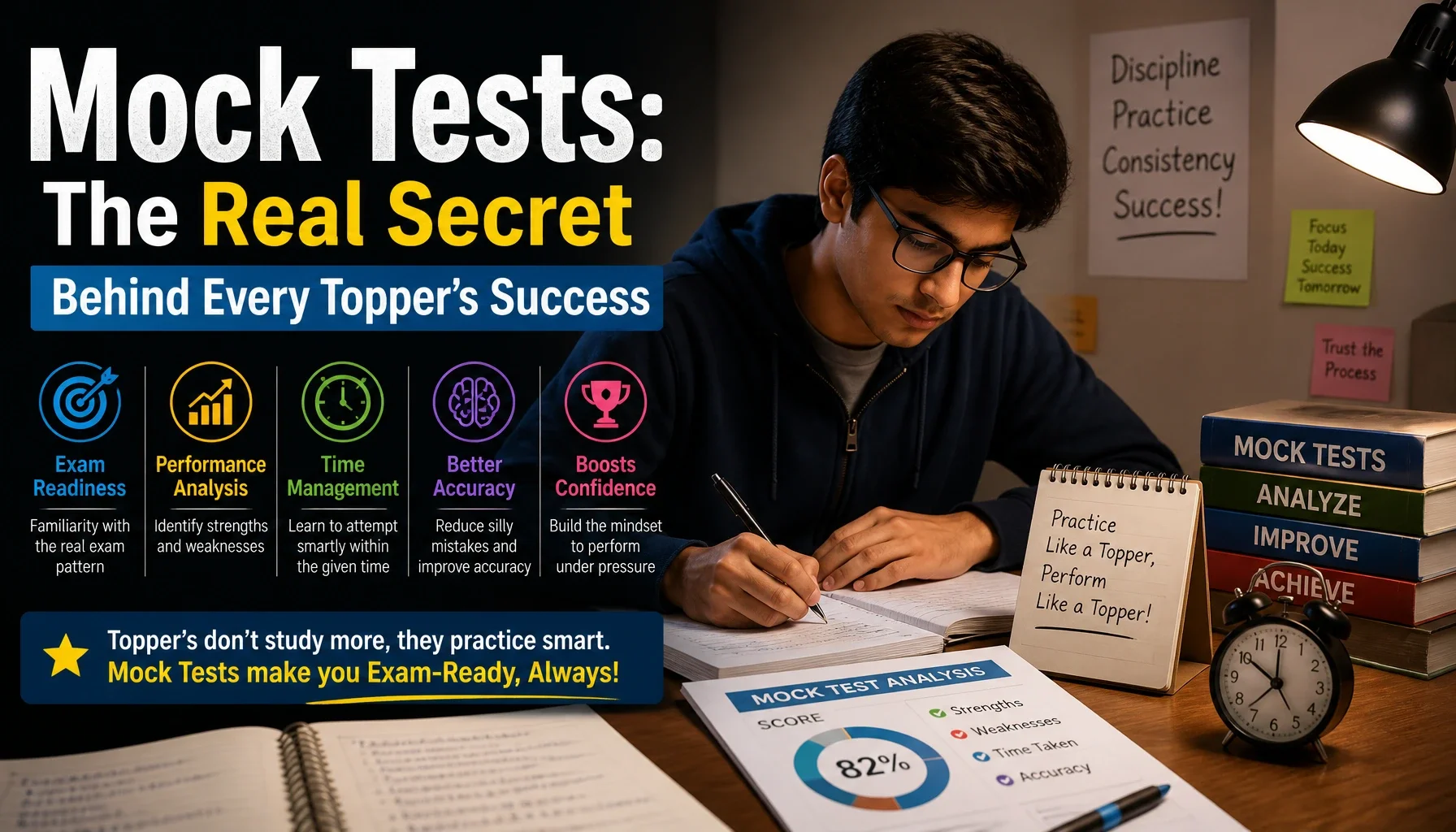
Whether it's a civil services exam, Groups, RRB, IBPS, or entrance tests like CAT, GATE, NEET, and JEE — ask any top ranker about their success formula and one answer repeats every single time: mock tests. Everyone reads the same books. Everyone gets the same 24 hours. Yet some candidates clear exams with excellent scores while equally talented aspirants scrape through with borderline marks. The difference? Structured, consistent mock test practice. That is exactly why experts insist — the more mock tests you write, the better your chances.
Table of Contents
However big your goal is, reading books and study material alone is never enough. Your preparation has value only when it converts into marks inside the exam hall. Knowledge comes from reading, but the ability to demonstrate that knowledge under exam conditions comes only from mock tests. Here's how they transform your preparation:
1. Understanding the Exam Pattern
No matter how well-prepared you are, without a clear grip on the question pattern, you will fall behind in competitive exams. Mock tests reveal how questions are framed, in how many formats they appear, and at what difficulty level. You also develop a fair estimate of the weightage each chapter carries. In short, you get a complete grip on the paper — so nothing surprises or pressures you on the actual exam day.
2. Escaping the Negative Marking Trap
Negative marking pours cold water on many aspirants' dreams. Every objective question tempts you into believing your answer is correct — one careless tick, and marks you rightfully earned are lost. The only way to build immunity against this is writing as many mock tests as possible. You learn where paper-setters lay traps and where you personally tend to slip.

3. Mastering Time Management
Everyone has favourite and weak subjects. If you don't want your weak areas to drag down your overall result, you must know exactly how much time to allocate to each section — and that judgment develops only through mock tests. You also build the habit of skipping a stubborn question and moving on instead of stubbornly wasting time thinking "somehow I must crack this one." Following the same tested strategy in the real exam directly improves your rank.
4. Discovering Strengths and Weaknesses
Normally we distribute study time equally across subjects and assume everything is fine. Which subject is actually pulling you back becomes visible only through mock test results. Based on them, you know precisely where to invest more time and which concepts still need polishing.
5. Percentile Awareness
In exams like CAT or JEE, your percentile matters more than your raw marks. A mock test scorecard analysed against thousands of fellow test-takers tells you exactly where you stand in the competition — well before the actual exam does.
6. Growing Confidence
Scores in mock tests build genuine self-belief. And if you score below expectations, proper analysis lets you make the necessary corrections in practice itself — not after the real exam, when it's too late.
7. A Stress-Proof Mind
Big or small, the word "exam" itself frightens many candidates — some even freeze in simple slip tests. Mock tests are the correct cure for that phobia. They condition your mind and brain to the exam atmosphere well in advance, so you stay calm and composed on the final day.
8. Careful, Accurate Attempts
In the hurry to answer quickly, we sometimes misread questions — and realise the mistake only after solving, wasting precious time. Mock tests eliminate this problem. Repeated practice sharpens your ability to decode complex questions easily and conquers even the small errors born out of carelessness.
9. Racing Against the Clock
Almost every competitive exam is a battle of solving maximum questions in minimum time — some questions don't even deserve half a minute. To secure a rank in such conditions, your brain must work like mercury. Mock tests develop exactly that ability: rapid analysis of questions and quick, confident decision-making.
10. Self-Analysis
"Did I study? Did I write mock tests?" — that checklist mentality is useless. What truly matters is reviewing how much you improved from one test to the next. Based on that, measure the distance to your target and keep adjusting your study plan accordingly.
11. Building a Personal Strategy
Everyone studies; everyone writes the exam. To stand out among them all, you need your own unique strategy. Which subject to attempt first, how much time to give each question type, which questions to leave — mock tests answer all of this. Experiment with different approaches, see which works best for you, and adopt it. Follow smart tactics like "which chapters produce the most questions?" and "which ones can be safely skipped?"

12. Effective Revision
Review the mistakes you make in mock tests from time to time and plan your revision around them. If you simply stop repeating your errors, within about ten days you can write a near-perfect exam without giving your old mistakes any room.
How to Get the Most Out of Mock Tests
- Start early: In the initial phase of preparation, write one mock test per week. As the exam approaches, steadily increase the frequency.
- Simulate real conditions: Write mocks at the same time slot as the actual exam, in a similar environment.
- Maintain an error notebook: Record every mistake made during preparation and mock tests. Regularly flipping through it prevents those errors from repeating.
- Allocate analysis time: Time spent analysing your mock test mistakes is never a waste — real victory begins after the test. Experts call this the 3-Step Analysis: divide your wrong answers into three categories. (1) Concept gaps — re-read those topics. (2) Calculation errors despite knowing the concept — practise more. (3) Misunderstood questions — work on concentration.
A Word of Caution
Never treat mock or grand test scores as a measure of your talent — they are learning tools, nothing more. In entrance and competitive exams, every mark matters and every second counts. But if scores dip, don't get discouraged; treat it as a red flag, identify where the gap lies, and change your strategy as quickly as possible. Remember: your grip today is tomorrow's appointment letter — or your admit card to a top college.

Comments